Introduction
The world of medical device manufacturing is one where a micron-sized burr can cause tissue trauma, a variation of a few microinches in surface roughness (Ra) can prevent cell adhesion, and a microscopic foreign body in a material can cause an inflammatory response in a patient. These “invisible” defects are the cause of failed clinical trials, delayed regulatory approvals, and catastrophic product recalls. The cost of these defects is not just in terms of tens of millions of dollars but also in terms of corporate reputation and, worst of all, patient safety.
The crux of the matter is that many precision machining suppliers assume that “medical grade” means nothing more than “tighter tolerances.” The fact is, real medical manufacturing is about systemic biocompatibility assurance, a full data chain traceable to raw material, and preventative contamination control processes. The underlying problem is a basic lack of understanding of the underlying intent of quality system initiatives like ISO 13485. This article demonstrates that real medical grade CNC machining is an integrated engineering system of materials science, ultra-tight process control, and measurable metrology to drive part non-conformity reduction.
What Does “Medical-Grade Precision” Really Mean Beyond the Drawing?
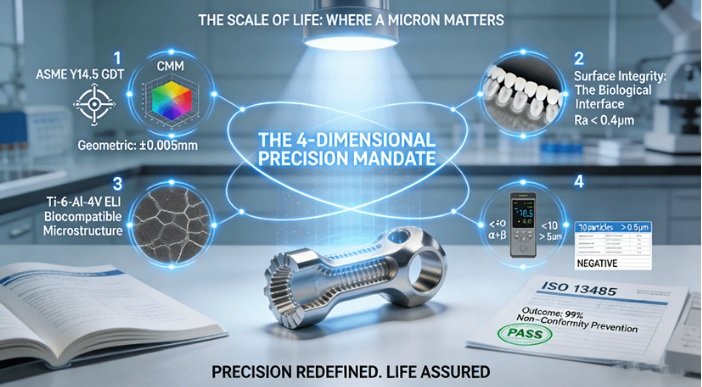
“True medical precision” is a multi-dimensional specification that goes far beyond a simple callout on a 2D drawing. It includes at least four different dimensions that are crucial for in-vivo performance and compliance with medical device regulations. Geometric precision, or traditional tolerancing, is the first dimension, although in many cases, surface integrity — the lack of micro-cracks, white layer, and Ra/Rz values optimized for specific biological response — is more important. The third dimension is microstructure, or the state of the material, where post-processing microstructure must be consistent with the certified properties of the alloy, with no detrimental microstructure like delta ferrite present. The fourth dimension is functional cleanliness, which is a given in medical components.
1. The Regulatory Mandate: Precision as a System Output
Regulatory bodies, such as the FDA, in their Quality System Regulation (QSR), demand that precision is an assured system output, not a hoped-for result of well-designed equipment. This means a change in emphasis from end-product inspection to validation and control of the entire process, from programming through post-processing, with a requirement for manufacturers to demonstrate their ability to ensure their entire workflow meets all design specifications.
2. Surface Finish: The Interface with Biology
When we produce medical components, the surface is essentially our point of contact with the human body. A machining method should be planned in such a way that the surface is optimized for biological response, fixation, or sliding motions. It may include special toolpaths or cutting conditions, and also electropolishing or other … To reach this result, we must learn about surface roughness and also about how the process and material interact.
3. The Data-Driven Definition of a “Good” Part
In this sense, a part that conforms does not merely mean a part that has passed a final gauge inspection. It means a part that has a full and verifiable digital history that demonstrates that all requirements — geometric, surface, material, cleanliness — were accomplished by a controlled process. This all-encompassing definition is the basis for medical device quality, and traceability and documentation are just as important as the physical machining. This complex requirement is mastered by those with a clear understanding of how a given process accomplishes these tasks, which is discussed in depth in terms of the capabilities for precision CNC milling services.
Titanium, Stainless Steel, or PEEK? Machining the “Biocompatible” Without Compromise
The selection of a biocompatible material is the beginning of the solution. However, the true challenge comes when the material needs to be machined without compromising its biocompatibility. There are unique machining challenges associated with every popular medical-grade material. Machining Ti-6Al-4V ELI, the material of choice for orthopedic implants due to its low elastic modulus, can be a challenge as the material tends to vibrate due to its low elastic modulus. Machining 316LVM stainless steel, the material of choice for surgical instruments, can be a challenge as the material tends to harden during machining.
l The PEEK Paradigm: Managing Heat and Stress: Engineering materials like PEEK pose a unique challenge. While they are biocompatible and allow for the creation of radiolucent parts, they are subject to heat stress as well as machining stress. Using standard metal-cutting techniques may result in melting the material or causing stress that will result in early failure. A variety of special tooling is required for machining these materials. Additionally, a number of operations may be required to remove the material with the minimum stress. This is to ensure that the finished product has the required properties.
l Coolant and Contamination: The Invisible Variable: Choosing a coolant is a major factor when selecting a compliance tool with biocompatibility. Some industrial coolants may have toxic residues to the human body. Besides, it may be almost impossible to remove these contaminants entirely. Machining coolants of medical grade usually utilize a w… This is due to the fact that testing the coolant to be sure it is leaving no residues is simpler. The coolant is a key tool in the machining process. Choosing a medical-grade coolant product is critical to ensure that the end item will not have a secondary source of contamination.
l A Tailored Approach for Every Material: There is no set of universal parameters for medical-grade materials. The cutting speed, feed rate, depth of cut, tool path strategy, etc., must be carefully designed and frozen for each material grade or part type. This is a fundamental difference between a vendor that merely cuts metal versus a vendor that provides a biocompatible part that meets a customer’s requirements. It is a key component of high-end CNC machining services for complex parts milling.
The “Chain of Custody”: How is Every Part’s History Documented from Mill to Patient?
In medical parts machining services, the part and data are a package deal. Each part, from a simple surgical device to a complex spinal implant, must have an unchallengeable digital fingerprint that documents its history from birth. This digital chain of custody starts with the material itself; a certified mill test report must be provided that describes the material’s composition, any heat treatment, and mechanical properties. Each subsequent event in the part’s history — machining data, inspection results, cleaning data, sterilization data — is digitally recorded and linked back to the unique material lot number and part number.

1. The Digital Thread in Action
A high-end manufacturing execution system is the key technology that drives this traceability. The system automatically records the CNC program used, the tooling ID, spindle speeds, and feed rates for all operations. Probing data and post-process inspection results from CMM or vision inspection can be appended to the digital record. This closed-loop data trail not only proves that a process was followed but can also be used for root-cause analysis in the unlikely event an anomaly is detected. This process meets the stringent requirements for complete device history records as defined by the ISO 13485 standard.
2. From Data to Defensibility During Audit
The day a regulatory auditor or quality engineer from a medical device company wants to verify that a part was made from the right material, on a calibrated machine, and through a validated process, and that all inspections passed — all in a moment’s notice — the answer is this digital passport. The ability to instantly retrieve the entire history for a given part shipped out the door and prove that all processes were followed is the ultimate sign of a world-class medical manufacturing quality system.
3. The Supplier as a Guardian of Data Integrity
Thus, the role of a medical manufacturing partner extends beyond the physical fabrication process to also serve as a data integrity guardian. The data must be immutable, time-stamped, and securely stored for the lifespan of the device plus regulatory storage requirements. This is what gives device manufacturers the certainty they need. The ability to affix an impeccable ‘digital quality passport‘ to each physical device is what a top-tier medical industry CNC milling parts manufacturer does as a matter of routine.
From 10 Prototypes to 10,000 Implants: Does Your Process Scale Without “Amnesia”?
A flawless prototype is a promise, but mass production is the test of a system. One of the greatest risks in medical device development is “knowledge loss” — the hand-crafted process perfected by an R&D engineer on one machine failing when transferred to a production cell worked on by different people. The answer is to lock and transfer processes. This means converting all the empirically optimized process parameters developed during the prototype process into standardized work instructions and statistical process control plans for mass production.
1. The Protocol for Process Validation
To validate scale precision, formal validation is the only way. It means that a first-rate medical supplier does not just “run more parts. ” Instead, they carry out a validation protocol Installation Qualification, Operational Qualification, Performance Qualification.This means that they have to validate that production equipment is properly installed, that it operates within set limits, and that it produces a part that meets all the design requirements. This validation is the foundation for all production from now on to ensuring that the 10,000th implant is statistically identical in every way to the device used in the pivotal clinical trial.
2. Knowledge Management: From Tribal to Institutional
The methodologies described in IATF 16949 for Production Part Approval Process and ISO 13485 for design transfer are, in essence, a systematic approach for codifying R&D “success knowledge” into a production control methodology that can be audited and repeated. This transition from “tribal” knowledge, where a few engineers understand what must be done, into “institutional” knowledge, where it is formally documented, formally communicated, and formally implemented, is what keeps production from suffering a form of “amnesia” as scale-up occurs.
3. Ensuring Consistency Across Shifts and Lots
The key challenge in volume production is consistency. A validated process controlled by a Statistical Process Control program measures key characteristics in real-time, giving a warning on trends before parts become defective. When paired with a robust tool management program and maintenance schedules, this holistic philosophy guarantees that parts built on the night shift or six months later are just as tightly controlled statistically as the initial validation run. Precision at volume is no longer just a dream.
The Auditor’s Checklist: 5 Questions to Vet a True Medical Manufacturing Partner
In order to vet a medical machining partner, one must shift from a procurement philosophy into an audit philosophy. What are the key questions that one must ask? First, ask for a copy of their Design History File and Device Master Record for a previously manufactured, commercially available medical device. This will give insight into their documentation philosophy and their grasp of the product development lifecycle. Second, ask them about their cleanroom or controlled environment standards. What is their ISO classification? How do they monitor it? What are their material flow procedures?
- Probing Contamination Control and Corrective Action: Third, dig deeper on their contaminant control: How do they control and validate the biocompatibility and residue of their cutting fluids, cleaning solutions, and packaging materials? Ask to see the test results. Fourth, probe their Corrective and Preventive Action system: Prepare a scenario for a non-conformance situation and ask the supplier to take you through their 8D process to ensure the root cause is corrected and the problem does not recur. A weak CAPA is a significant red flag for any regulatory agency.
- Simulating the Regulatory On-Site Audit: Fifth, and most insightful, is to ask the supplier to prepare for a mock regulatory audit. A self-assured and competent supplier will eagerly agree to this, as it simulates their readiness for an FDA or Notified Body audit. Their smooth navigation of the quality manual, procedures, and plant floor with your pointed questions is the ultimate measure of a quality culture that is more than just a piece of paper.
- The Partner as an Extension of Your Quality System: Your machining partner is ultimately an extension of your own quality system. Their quality system will have a direct impact on the safety and efficacy of your product. The international standard for these requirements can be found in an ISO 13485 type framework. The selection of a partner that is certified and one that lives and breathes these principles of a quality system is arguably the most important decision in outsourcing mission-critical components for medical devices. The evaluation process for a CNC milling quote becomes less about price and more about a risk assessment.
Conclusion
In the life-critical realm of medical devices, the selection of a precision machining supplier is not just a simple supply chain decision. It is a strategic partnership where engineering excellence, quality philosophy, and regulatory know-how are integrated. By applying an evaluation methodology that goes beyond the boundaries of geometric dimensioning and tolerancing to materials science, entire-process data traceability, and risk management, medical device manufacturers can turn external manufacturing into a source of security rather than risk. This is not just making parts; this is co-building security to safeguard life.
FAQs
Q: What is the smallest feature size and tightest tolerance that can be achieved for medical micro-components by CNC milling?
A: By employing a micro-milling method and particular tools, it is possible to have machined parts feature size 0. 1 mm and a tolerance of 0. 005 mm. Such a machine must be highly capable and provide excellent thermal and vibration stability in order to meet the very demanding requirements of parts such as micro-fluidic channels or complex geometries for surgical instruments.
Q: How do you ensure and document the biocompatibility of machined parts, especially when surface treatments are involved?
A: The biocompatibility of your machined parts will be assured by using certified raw materials (with corresponding ISO 10993 certificates), cleaning processes that will make sure all components are free from contaminants, and surface treatments. The whole process dossier will be compiled to support your regulatory submission and will include every step that affects the biocompatibility of your final part.
Q: Are CNC-milled parts available clean, ready for a sterile environment?
A: Actually, the parts can be cleanroom-packaged, e.g. Class 100K, with the option of validated sterilization processes, including autoclaving, gamma, or EtO. This can be your device master record’s valuable aid. In other words, this will help you ensure that the parts are ready for integration in your final assembly or packaging processes.
Q: What documentation is included with the medical-grade CNC milled parts?
A: We include a comprehensive Device History Record with every order, which contains a variety of documentation, including material certs, a complete First Article Inspection Report with CMM results, cleanliness documentation, as well as a certificate of conformity. This documentation package is intended to satisfy the requirements of the most demanding quality system.
Q: What is your process for going from prototyping (for the animal trials) into clinical production, and then finally into commercial production?
A: We follow a phased document-controlled procedure. We document our prototyping procedure; then we lock that procedure away and validate it for our clinical production. For our commercial production, we then transfer that validated procedure into a scaled-up line with SPC.
Author Bio
LS Manufacturing is a certified partner dedicated to bringing aerospace-grade engineering certainty to the medical device manufacturing industry. From concept to commercialization, they serve as a trusted extension of innovative medical technology enterprises. Are you seeking a manufacturing partner capable of delivering a “zero-risk” guarantee for the precision components of your next innovative medical device? Contact them today to make it a reality.